


Bitcoin,
A Strategic Asset For Corporates
Auranj White Paper
I. Executive Summary
Cash held in dollars loses purchasing power every year. That has been true for decades; between July 2020 and April 2026 it was true at a magnitude most corporate treasurers have not experienced firsthand. Cumulative CPI-U rose 27.8% [1], and a dollar idle at the start of that window buys roughly 78 cents of the same basket at its close.
The standard corporate response is to park cash in short-duration U.S. Treasury bills. This mitigates the loss without eliminating it. Over the same window, a $100,000 position in SGOV (iShares 0–3 Month Treasury Bond ETF) [8] with distributions reinvested would have retained about $92,700 in real July-2020 dollars. Better than cash. Still a loss.
Auranj proposes a different structure. A company deposits idle cash into a separately managed account, where principal is allocated to short-duration Treasury bills and money market funds. The yield those instruments generate, and only the yield, is systematically converted into Bitcoin at month-end. Principal is never used to purchase Bitcoin, and principal is never at risk.
The paper develops this thesis in two parts. The first is the structural case: monetary expansion is a persistent, policy-driven force; Bitcoin is the only reserve asset with enforced absolute scarcity; the regulatory and accounting environment has shifted from hostile to accommodating over the past two years; and the adoption curve, while still early, is accelerating. The second part is empirical. We ran a day-by-day backtest of the Auranj structure from July 1, 2020 through April 22, 2026 using public price and inflation data. Over the 5.81-year window, the Auranj portfolio finished at $100,855 in constant July-2020 dollars (+0.86% real return), versus $92,732 for SGOV-only (−7.27%) and $78,219 for idle cash (−21.78%). Auranj was the only structure to end above the real-dollar break-even line. Principal stayed within ±0.39% of the initial deposit for the entire window.
II. The Problem: The Silent Erosion of Corporate Treasuries
The Purchasing Power Trap
A company that held $10 million in cash throughout the last six years lost roughly $3 million in real purchasing power, with no corresponding entry on its income statement. The cash line item stayed at $10 million. The cash itself did not.
This is the loss that does not show up in quarterly reporting. The balance sheet shows a nominal figure, the income statement shows no realized impairment, and the economic reality, that the cash will buy materially less than it did, is absorbed silently into future operating costs.
T-bill Yields Do Not Compensate
The standard answer to the purchasing power trap is to move cash into T-bills or a money market fund. It works, partially. Real yields on the short end of the U.S. Treasury curve have been negligible or negative for most of the past fifteen years, with brief exceptions in 2023–2024 when the Federal Reserve held the policy rate above 5 %.
The backtest reported later in this paper quantifies the shortfall directly. An SGOV-only portfolio with distributions reinvested, a defensible choice for any treasurer, lost 7.27 % in real terms across the July 2020 – April 2026 window. The shortfall is about the regime, not the instrument. When CPI compounds faster than short-rate yield, T-bills slow the bleeding but can't stop it.
M2 Expansion: The Structural Driver
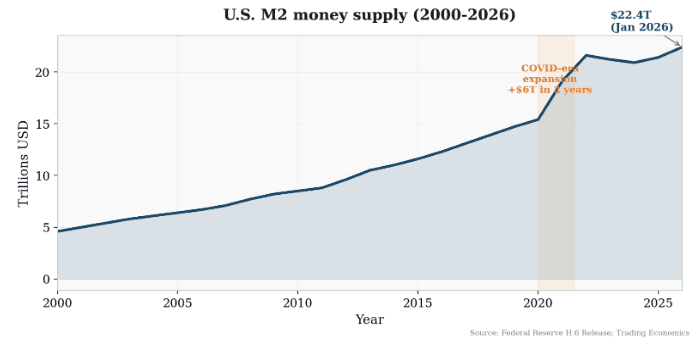
The U.S. M2 money supply grew from approximately $15.4 trillion in January 2020 to $22.4 trillion by January 2026, an increase of roughly 45 % in six years [2]. The U.S. national debt has crossed $36 trillion. Annual deficits have remained above $1.5 trillion in recent years, and fiscal year 2025 is on track for more than $3 trillion.
None of this is cyclical. With deficits of that magnitude structural, the pressure on dollar purchasing power is not a transient phenomenon. It is policy.
A Strategic Problem, Not An Operational One
Corporate treasury work has traditionally been framed as operational: optimize the cash conversion cycle, sweep idle balances into money market funds, minimize float. That framing is too narrow for the environment just described. The challenge is no longer only about optimizing cash. It is about protecting the real value of capital a company has already earned.
III. The Macro Context: Why This Problem Is Accelerating
Fiscal Trajectory Of The United States
The fiscal arithmetic is not in dispute. Interest expense on the federal debt has now passed defense spending. Net interest is projected to exceed $1 trillion for fiscal year 2026. Against that backdrop, a return to a hard-money policy stance would require a political consensus that does not currently exist.
The Institutional Consensus Is Shifting
On March 6, 2025, President Trump signed an executive order establishing a U.S. Strategic Bitcoin Reserve [3]. The White House described Bitcoin as "digital gold" with a "strategic advantage" to holding. Whatever one's politics, the signal is directional: a sovereign state has moved from treating Bitcoin as a regulatory problem to treating it as a reserve asset. State-level action has followed. Texas signed SB 21 into law on June 22, 2025, creating the Texas Strategic Bitcoin Reserve [4].
Central banks across Europe and Asia have continued to add to gold holdings at a pace not seen since the 1960s. The underlying motivation is the same: a search for reserve assets whose supply is not controlled by another country's treasury.
IV. Bitcoin As A Treasury Asset: The Investment Thesis
Absolute Scarcity
Bitcoin's total supply is capped at 21 million units by its protocol. The cap is not a policy target that can be revised by a committee. It is enforced by code, validated by a global network of nodes, and has remained unchanged since Bitcoin's inception in 2009. Gold's supply grows by roughly 1.5 % per year through mining. M2 has grown at several times that pace over the same window. Bitcoin's issuance is already past the midpoint of its schedule and continues to halve every four years.
For a corporate reserve, absolute scarcity is the property that matters. No fiat currency can claim it.
The Legitimization Arc
Two shifts in the past three years have removed most of the structural objections to a corporate Bitcoin allocation.
Spot Bitcoin ETFs. By Q1 2026, total U.S. spot Bitcoin ETF assets under management exceeded $128 billion, with cumulative net inflows surpassing $65 billion since inception. BlackRock's iShares Bitcoin Trust (IBIT) alone crossed 800,000 BTC in holdings and surpassed $100 billion in AUM, one of the fastest-growing ETFs in history [7].
FASB ASU 2023-08 [5]. Under the previous accounting standard, a company holding Bitcoin could only mark down losses, never recognize unrealized gains until sale. This was a one-sided penalty that made Bitcoin on a corporate balance sheet look worse than it actually was. The new standard, effective for fiscal years beginning after December 15, 2024, requires fair value reporting with changes recognized in net income. The accounting treatment is now symmetric.
V. The Adoption Wave: Corporate Bitcoin Treasury In 2025–2026
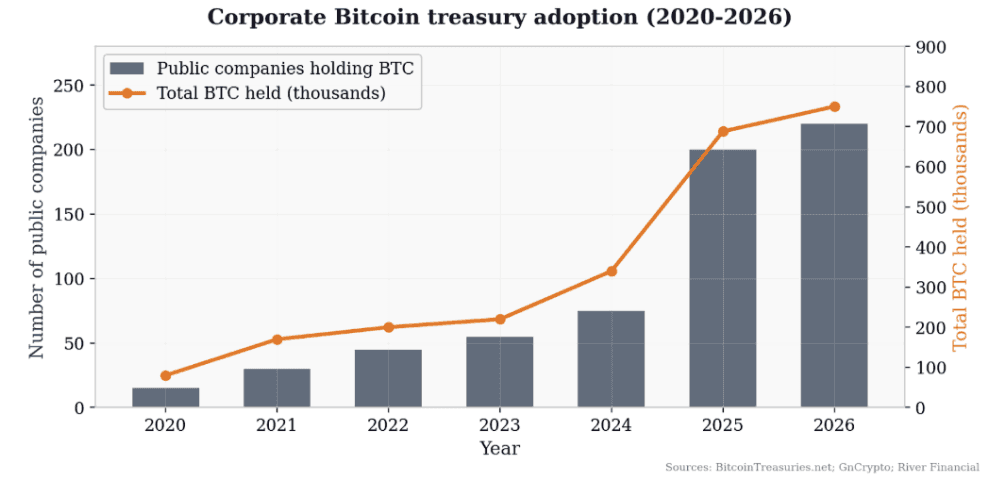
By late 2025, roughly 200 publicly traded companies worldwide held Bitcoin on their balance sheets, nearly three times the number from a year earlier. Collectively they held over 688,000 BTC.
The pattern is not limited to large public companies. Businesses now hold about 6.2 % of total Bitcoin supply, approximately 1.3 million BTC, a 21-fold increase since January 2020. Roughly 75 % of business
The Gap That Remains
Despite this growth, fewer than 1 % of U.S. businesses currently hold Bitcoin. The infrastructure is in place. The accounting standards have been updated. The regulatory posture has shifted from hostile to accommodating. What is still missing, for most companies, is a product designed to make the first step safe and simple.
VI. Why Companies Should Build A Bitcoin Reserve
Balance Sheet Valuation
Traditional corporate finance focuses heavily on the income statement: revenue growth, margins, earnings per share. But a company’s valuation also reflects the quality and composition of its balance sheet. Bitcoin treasury companies have demonstrated this. Strategy (formerly MicroStrategy) abandoned traditional profit-based valuation in favor of balance-sheet metrics, most notably mNAV (market multiple of net asset value), which measures how the market prices the company relative to its Bitcoin holdings.
The results have been striking. Strategy’s stock delivered a roughly 2,760% return since its first Bitcoin purchase in August 2020, compared to Bitcoin’s own 823% appreciation over the same period. The market assigned a persistent premium to NAV, at points exceeding 2.7x, because investors were pricing in not just the current Bitcoin holdings but the company’s capacity to grow those holdings over time.
The lesson is consistent: a balance sheet that holds a scarce, appreciating asset can command a market premium that a cash-heavy balance sheet eroding to inflation cannot. For any company with idle cash sitting in low-yield instruments, the decision to accumulate Bitcoin is also a decision about how the market will value the company over time.
Bitcoin as collateral: borrowing against BTC without selling
Bitcoin is liquid, divisible, and increasingly accepted as collateral by institutional lenders. A company can borrow against its Bitcoin holdings for payroll, capital expenditure, project financing, or working capital, without selling the underlying position and without triggering a taxable event. JPMorgan Chase announced in 2025 that it would allow institutional clients to borrow against Bitcoin holdings.
The result is a compounding structure. Treasury yield buys Bitcoin. Bitcoin unlocks borrowing capacity. Borrowed capital funds operations without forcing a sale.
Market-neutral yield: making BTC productive without selling
Basis trades, holding spot BTC while shorting BTC futures to capture the premium between spot and futures prices, have produced meaningful yields on Bitcoin holdings. CF Benchmarks and CME Group data show annualized front-month basis near 25 % in early 2024 [9]. Securitize reported a combined yield of about 20.7 % by running a Bitcoin basis trade alongside a BUIDL-fund-as-collateral strategy [10].
The upshot is that Bitcoin held on a balance sheet can itself be put to work, without being sold.
VII. The Barrier: Why Most Companies Have Not Acted
Volatility and fiduciary risk
A CFO or board member considering a direct Bitcoin allocation faces the prospect of reporting a 20–30 % drawdown in a single quarter. For most companies, reporting that kind of principal impairment on treasury holdings is incompatible with fiduciary responsibility. The real risk here is the shape of the quarterly path, not the long-run expected return.
This objection is the single strongest reason most qualified companies have not acted, and it is correct, as long as the question is a direct principal allocation.
Accounting complexity
Even with FASB ASU 2023-08 in place, fair-value reporting introduces income-statement volatility. Companies must now report unrealized gains and losses in net income each period. For companies optimizing around smoothness of quarterly earnings, that is an additional reason to keep the Bitcoin position small or nonexistent.
Lack of adapted infrastructure
The existing on-ramps to Bitcoin are designed primarily for three categories of users: retail investors (exchanges like Coinbase, Cash App), institutional traders (prime brokers, OTC desks), and large-scale treasury companies following the Strategy model (issuing debt and equity to purchase Bitcoin directly). None of these is optimized for a mid-market company with $5 million to $100 million in idle cash that wants Bitcoin exposure without principal risk. There is no product that bridges traditional corporate treasury management with systematic Bitcoin accumulation.
VIII. The Auranj Approach: Yield-Funded Bitcoin Accumulation
How it works
Auranj operates as a separately managed account (SMA) provider for U.S. companies. The core mechanism is designed around a single principle: accumulate Bitcoin without risking the principal.
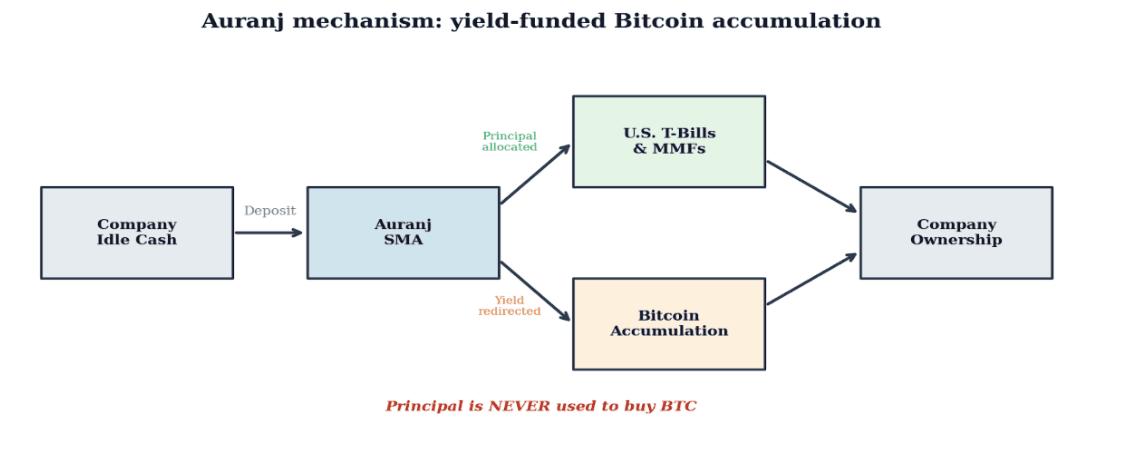
A company deposits idle cash into its Auranj-managed account. The principal is allocated to short-duration, low-risk instruments, specifically U.S. Treasury bills and money market funds. These instruments generate yield. That yield is systematically used to purchase Bitcoin on behalf of the company. The company retains full ownership of both the cash instruments and the BTC.
Deposit: Company deposits idle cash into its SMA
Principal allocation: Allocated to U.S. T-bills and money market funds
Yield generation: Short-duration instruments generate yield
Bitcoin accumulation: Yield is used to purchase BTC systematically
Principal exposure: Principal is never used to buy BTC and is never at risk
Ownership: Company retains full ownership of both cash instruments and BTC
Positioning within the corporate treasury workflow
Auranj is designed to fit into how corporate treasuries already operate. The SMA structure means each company has a segregated account with transparent reporting. There is no commingling of assets. The underlying instruments (T-bills, MMFs) are familiar to any CFO. The Bitcoin accumulation is systematic and passive, requiring no active trading decisions from the company. Auranj charges a management fee on assets under management; the principal is never touched for fee collection.
IX. Empirical Validation: Backtest Results, July 2020 – April 2026
The remainder of this section presents a day-by-day simulation of the Auranj structure against two benchmarks, using public data (SGOV NAV and distributions from Yahoo Finance, BTC-USD from Yahoo Finance [11], CPI-U from FRED [1]).
Full code can be find in the following repository: https://github.com/auranjco/backtest
The Headline Chart
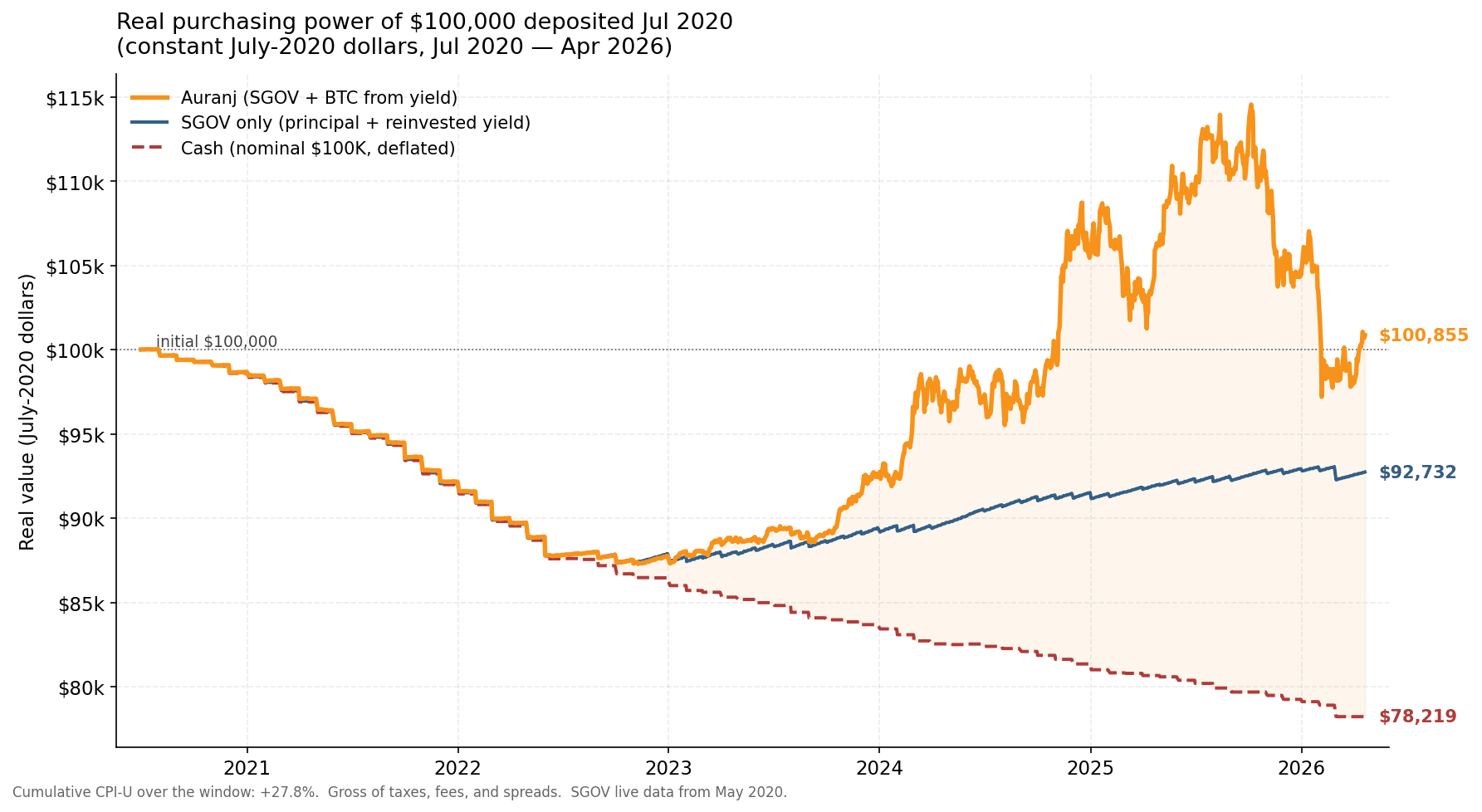
Figure 1 plots three portfolios that each start with $100,000 on July 1, 2020. Every line is expressed in constant July-2020 dollars, the only framing that places the three strategies on a shared yardstick.
Terminal real values:
Auranj: $100,855 (+0.86 % real)
SGOV-only (distributions reinvested) : $92,732 (−7.27 % real)
Idle cash: $78,219 (−21.78 % real)
Auranj is the only one of the three portfolios to finish above the initial real-dollar line. The Auranj-versus-cash gap at window end is $22,636 per $100,000 deposited, or about 22.6 percentage points of preserved real purchasing power.
The Nominal View
Figure 2 plots the same three portfolios without CPI deflation. It is included for traceability only. Because the cash line is not inflation-adjusted, it overstates the Auranj-versus-cash gap by the full 27.8 % CPI drift.

X. Regulatory And Accounting Tailwinds
FASB ASU 2023-08 [5]
Fair value reporting for Bitcoin holdings applies to all entities, public and private, for fiscal years beginning after December 15, 2024. Unrealized gains and losses now flow through net income symmetrically
SEC posture shift
SAB 121, which had required entities custodying crypto assets for others to record a liability on their balance sheets, was rescinded via SAB 122 in 2025 [6]. Custody banks can now hold Bitcoin for clients without the one-sided balance-sheet penalty that had effectively kept them out of the business.
State-level adoption
Texas signed SB 21 into law on June 22, 2025, creating the Texas Strategic Bitcoin Reserve. [4] Multiple other states have introduced similar legislation. At the federal banking level, the OCC and FDIC announced in March 2025 that banks no longer need advance permission to engage in cryptocurrency activities.
These changes collectively reduce the friction, legal ambiguity, and reputational risk associated with corporate Bitcoin holding.
XI. Conclusion
Two years ago, most of the conditions described in this paper did not exist. The accounting was punitive. The regulatory posture was hostile. There was no institutional on-ramp. The reasons a CFO could give for not acting were abundant and all of them were correct.
Those reasons are no longer the same reasons. The accounting is symmetric. The regulatory posture has shifted. The infrastructure is in place. And in the backtest reported in this paper, a corporate treasurer who deposited $100,000 on July 1, 2020 into the structure described here would have preserved real purchasing power on a 5.81-year window in which both idle cash and a reinvested T-bill portfolio did not.
We believe corporates holding large cash balances will not take the bet to convert those balances into direct Bitcoin positions. What they will do, when the right product is in front of them, is redirect the yield on instruments they already hold into an asset they increasingly recognize as strategically important. The Auranj structure is that product.
XI. Sources
[1] U.S. Bureau of Labor Statistics, "Consumer Price Index for All Urban Consumers: All Items in U.S. City Average (CPIAUCSL)," Federal Reserve Economic Data (FRED), St. Louis, MO, 2026. https://fred.stlouisfed.org/series/CPIAUCSL
[2] Board of Governors of the Federal Reserve System, "M2 (M2SL)," Federal Reserve Economic Data (FRED), 2026. https://fred.stlouisfed.org/series/M2SL
[3] The White House, "Executive Order Establishing the Strategic Bitcoin Reserve," March 6, 2025.
[4] Texas Legislature, SB 21 (89R), signed June 22, 2025, establishing the Texas Strategic Bitcoin Reserve.
[5] Financial Accounting Standards Board, ASU 2023-08, "Intangibles—Goodwill and Other—Crypto Assets (Subtopic 350-60): Accounting for and Disclosure of Crypto Assets," December 2023.
[6] U.S. Securities and Exchange Commission, Staff Accounting Bulletin No. 122, 2025 (rescinding SAB 121).
[7] BlackRock, "iShares Bitcoin Trust (IBIT) Fund Factsheet," 2026.
[8] iShares, "iShares 0–3 Month Treasury Bond ETF (SGOV) Fund Factsheet," BlackRock, New York, NY, 2026.
[9] CF Benchmarks and CME Group, "Bitcoin Futures Basis Reports," 2024.
[10] Securitize, "Tokenized Asset Yield Report," 2024.
[11] Yahoo Finance, "Historical Market Data," 2026. https://finance.yahoo.com
[12] A. F. Perold and W. F. Sharpe, "Dynamic strategies for asset allocation," Financial Analysts Journal, vol. 44, no. 1, pp. 16–27, 1988.